Verbs
A verb is a word that shows an action, a state, or an occurrence. Every complete sentence needs a verb because verbs tell us what the subject does, is, or feels.
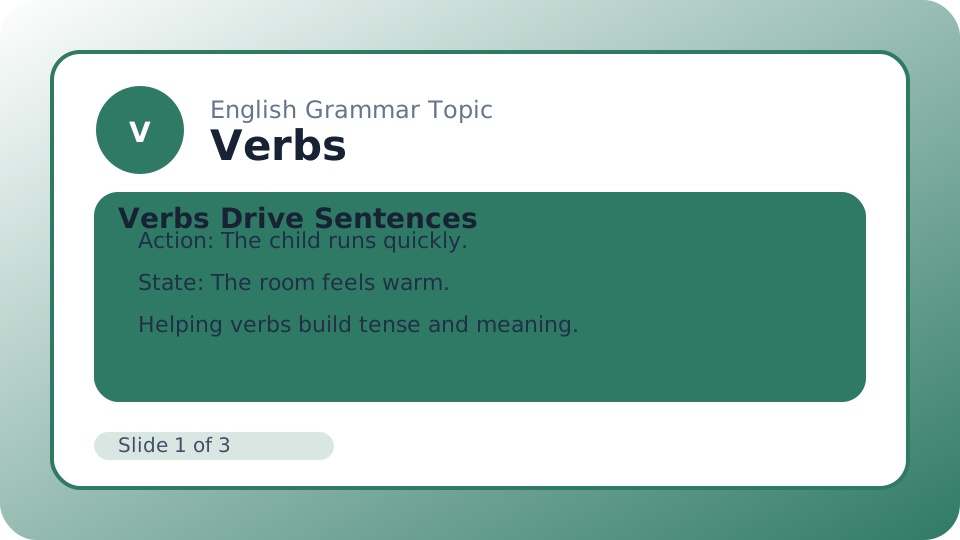
Visual Guide
Tap to view the presentation slides
Video Lesson
Watch a guided explanation
Audio Recap
Listen to a quick 60-second summary
Why learning verbs is important
- Show actions such as run, write, and speak.
- Describe states such as is, seem, and belong.
- Help express tense, voice, mood, and condition.
- Connect the subject to important information in the sentence.
| Type | Definition | Example |
|---|---|---|
| Action Verb | Shows physical or mental action | write, laugh, think |
| Linking Verb | Connects the subject to more information | is, become, seem |
| Helping Verb | Supports the main verb | is, have, do, will |
| Modal Verb | Shows ability, advice, or possibility | can, should, may |
| Transitive Verb | Takes a direct object | read a book |
| Intransitive Verb | Does not take a direct object | sleep, arrive |
| Phrasal Verb | Verb plus particle with a combined meaning | give up, look after |
Action, Linking and Helping Verbs
These are the most important groups of verbs for beginners. Knowing the difference helps you identify sentence meaning faster.
| Verb Type | Function | Example |
|---|---|---|
| Action Verb | Shows what the subject does | The students write neatly. |
| Linking Verb | Joins subject to a noun or adjective | The sky looks clear. |
| Helping Verb | Supports the main verb | She has finished her work. |
Examples in Context
- The cat jumped onto the sofa.
- My uncle is a pilot.
- They are preparing for the exam.
Main Verb, Helping Verb and Modals
Helping verbs and modal verbs add shades of meaning such as ability, necessity, possibility, and future time.
- Primary Helping Verbs: be, have, do
- Modal Verbs: can, could, may, might, shall, should, will, would, must
- Use: Use helping verbs before the main verb: She has written a letter.
RULE 1: Do not add -s to a verb after a modal. Write can speak, should go, will work.
RULE 2: Use do, does, and did to make negatives and questions in simple tenses.
RULE 3: Use have, has, or had with the past participle for perfect tenses.
Examples in Context
- She can solve this problem alone.
- Do they understand the instructions?
- He has visited Chennai twice.
Transitive, Intransitive and Phrasal Verbs
Some verbs need an object to complete their meaning, while others do not. Phrasal verbs combine a verb with a particle to create a new meaning.
Examples in Context
- Please turn off the lights before leaving.
- The train arrived on time.
- She looked after her little brother.
Subject-Verb Agreement and Common Errors
Verbs must agree with their subjects in number and person. This is one of the most important grammar rules in English.
RULE 1: A singular subject takes a singular verb: The teacher explains the topic well.
RULE 2: A plural subject takes a plural verb: The teachers explain the topic well.
RULE 3: With he, she, and it in the simple present, add -s or -es: He runs fast.
Examples in Context
- Incorrect: She go to school by bus. Correct: She goes to school by bus.
- Incorrect: The players was tired. Correct: The players were tired.
- Correct: Either Rani or her friends are planning the event.
Practice Exercises
Test your understanding of this concept.
Q: Q1. Identify the helping verb: They have finished the painting.
Answer: have
Q: Q2. Choose the correct verb: My brother (play / plays) football every evening.
Answer: plays
Q: Q3. Write one phrasal verb with look.
Answer: look after / look for / look into