Types of Sentences
Sentences can be grouped by purpose. The four main types are declarative, interrogative, imperative, and exclamatory.
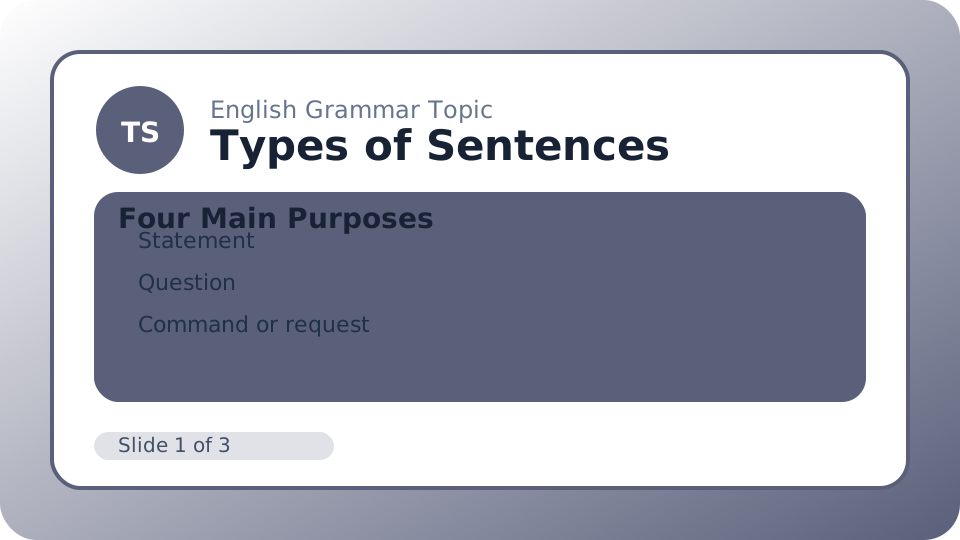
Visual Guide
Tap to view the presentation slides
Video Lesson
Watch a guided explanation
Audio Recap
Listen to a quick 60-second summary
Why learning types of sentences is important
- State facts and opinions clearly.
- Ask questions in direct and polite ways.
- Give commands, requests, and advice.
- Express strong feelings such as surprise, joy, or anger.
| Type | Definition | Example |
|---|---|---|
| Declarative Sentence | Makes a statement | The train is late. |
| Interrogative Sentence | Asks a question | Is the train late? |
| Imperative Sentence | Gives a command or request | Please wait here. |
| Exclamatory Sentence | Shows strong feeling | What a long delay this is! |
Declarative Sentences
A declarative sentence gives information, states an opinion, or reports a fact. It usually ends with a full stop.
Tip: Use declarative sentences when you want to explain, inform, or describe calmly and clearly.
Examples in Context
- The museum opens at ten o clock.
- Our class enjoyed the science exhibition.
- Honesty builds trust in a team.
Interrogative Sentences
An interrogative sentence asks a question. It may begin with a helping verb or with a wh-word such as who, what, when, where, why, or how.
| Question Type | Pattern | Example |
|---|---|---|
| Yes/No Question | Helping verb + subject + main verb | Are you ready for the test? |
| Wh-question | Wh-word + helping verb + subject + main verb | Why are you smiling? |
| Choice Question | Alternative options in one question | Would you like tea or coffee? |
Examples in Context
- Did the train leave on time?
- Where did you keep the files?
- Can we begin the meeting now?
Imperative and Exclamatory Sentences
Imperative sentences give instructions, requests, suggestions, or warnings. Exclamatory sentences express strong emotion.
RULE 1: The subject you is usually understood in imperative sentences: Open the door. (You open the door.)
RULE 2: Exclamatory sentences often begin with what or how and end with an exclamation mark.
Changing Sentence Types and Practice
One message can often be expressed in different sentence types depending on tone and purpose.
Examples in Context
- Declarative: You are coming with us.
- Interrogative: Are you coming with us?
- Imperative: Come with us.
- Exclamatory: How wonderful it is that you are coming with us!
Practice Exercises
Test your understanding of this concept.
Q: Q1. Identify the type: Please close the notebook.
Answer: Imperative
Q: Q2. Change to an interrogative sentence: You finished the project.
Answer: Did you finish the project? / Have you finished the project?
Q: Q3. Write one exclamatory sentence about rain.
Answer: Possible answer: What a heavy rain this is!