Sentence Structure
Sentence structure is the way words, phrases, and clauses are arranged to make clear meaning. A strong sentence usually needs a subject, a verb, and the correct order of ideas.
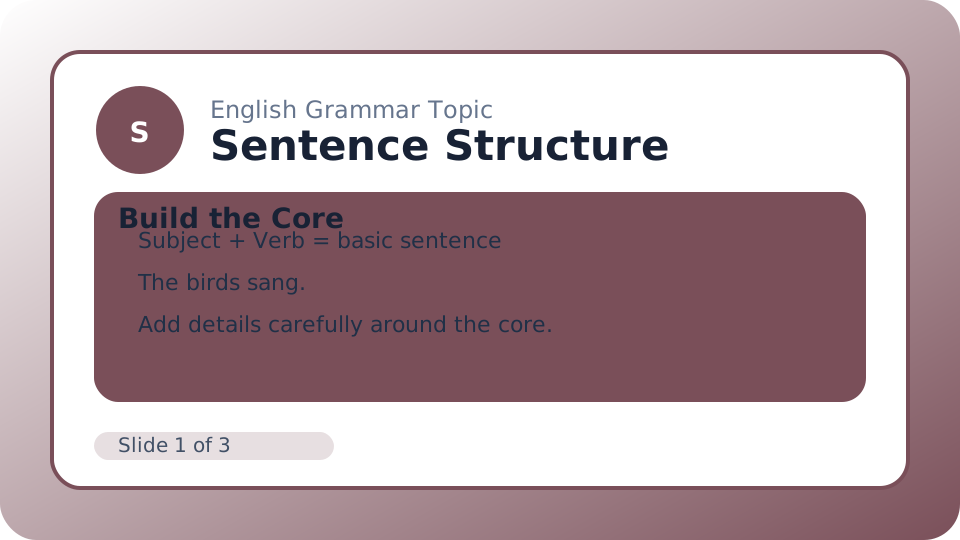
Visual Guide
Tap to view the presentation slides
Video Lesson
Watch a guided explanation
Audio Recap
Listen to a quick 60-second summary
Why learning sentence structure is important
- Arrange words in a meaningful order.
- Help speakers and writers express clear complete thoughts.
- Show relationships between ideas through phrases and clauses.
- Prevent fragments, run-on sentences, and confusing order.
| Type | Definition | Example |
|---|---|---|
| Subject | Tells who or what the sentence is about | The children |
| Predicate | Tells what the subject does or is | played in the park |
| Phrase | Group of words without a finite verb | in the morning |
| Clause | Group of words with a subject and verb | because she worked hard |
| Simple Sentence | One independent clause | The bell rang. |
| Compound Sentence | Two independent clauses joined together | The bell rang, and the class ended. |
| Complex Sentence | One independent clause plus one dependent clause | When the bell rang, the class ended. |
Subject and Predicate
The subject names who or what the sentence is about. The predicate tells what the subject does, is, or experiences.
| Sentence | Subject | Predicate |
|---|---|---|
| The baby smiled. | The baby | smiled |
| Our team won the match. | Our team | won the match |
| The road is narrow. | The road | is narrow |
Examples in Context
- My sister enjoys painting landscapes.
- The library opens at nine every morning.
- Those flowers smell lovely.
Phrases and Clauses
A phrase does not contain a finite verb, while a clause has a subject and a verb. Clauses may be independent or dependent.
Examples in Context
- The students waited in the corridor after lunch.
- When the teacher arrived, the students became quiet.
- I know the girl who won the prize.
Basic Sentence Patterns
English uses a few common sentence patterns. Recognizing them helps with writing and error correction.
| Pattern | Meaning | Example |
|---|---|---|
| S + V | Subject and verb only | Birds fly. |
| S + V + O | Subject, verb, object | She wrote a letter. |
| S + V + C | Subject, linking verb, complement | The sky became dark. |
| S + V + O + O | Indirect and direct object | He gave me a gift. |
| S + V + O + C | Object and complement | They elected Riya captain. |
Examples in Context
- The child laughed.
- The teacher asked a question.
- We painted the wall blue.
Fragments, Run-ons and Practice
Sentence problems happen when a thought is incomplete or when two complete thoughts are joined without proper punctuation or a connector.
RULE 1: A fragment is incomplete: Because the bus was late. Add a main clause to complete the idea.
RULE 2: A run-on joins two full sentences without correct punctuation: I was hungry I cooked rice.
RULE 3: Use conjunctions, semicolons, or full stops to separate complete thoughts clearly.
Examples in Context
- Fragment: After the meeting ended. Correct: After the meeting ended, we went home.
- Run-on: The shop was closed we came back. Correct: The shop was closed, so we came back.
- Correct: Because it was cold, we shut the windows.
Practice Exercises
Test your understanding of this concept.
Q: Q1. Identify the clause: We stayed indoors because it was raining.
Answer: because it was raining
Q: Q2. Name the sentence pattern: She opened the door.
Answer: S + V + O
Q: Q3. Correct the run-on: I reached home I called my mother.
Answer: I reached home, and I called my mother. / I reached home. I called my mother.