Pronouns
A pronoun is a word used in place of a noun or noun phrase. Pronouns help us avoid repetition, make sentences smoother, and show the relationship between speakers, listeners, and things.
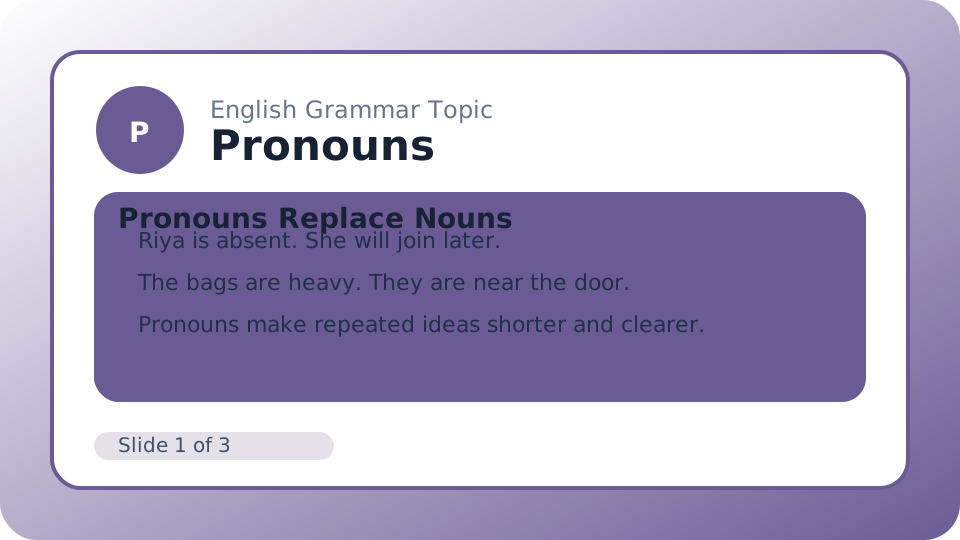
Visual Guide
Tap to view the presentation slides
Video Lesson
Watch a guided explanation
Audio Recap
Listen to a quick 60-second summary
Why learning pronouns is important
- Replace repeated nouns in a sentence or paragraph.
- Show person, number, gender, and ownership.
- Help form questions, comparisons, and relative clauses.
- Make speech and writing more natural and less repetitive.
| Type | Definition | Example |
|---|---|---|
| Personal Pronoun | Refers to speaker, listener, or others | I, you, he, they |
| Possessive Pronoun | Shows ownership | mine, ours, hers |
| Reflexive Pronoun | Reflects back to the subject | myself, yourself, themselves |
| Demonstrative Pronoun | Points to specific things | this, that, these, those |
| Interrogative Pronoun | Asks questions | who, whom, whose, what |
| Relative Pronoun | Connects a clause to a noun | who, which, that |
| Indefinite Pronoun | Refers to non-specific people or things | someone, anyone, few |
Personal Pronouns
Personal pronouns refer to people or things already known in the conversation. They change their form depending on whether they work as subjects or objects.
| Person | Subject Form | Object Form |
|---|---|---|
| First person singular | I | me |
| Second person singular/plural | you | you |
| Third person singular masculine | he | him |
| Third person singular feminine | she | her |
| Third person singular neuter | it | it |
| First person plural | we | us |
| Third person plural | they | them |
Examples in Context
- I finished the homework before dinner.
- The coach praised them after the match.
- She called me when the class started.
Possessive and Reflexive Pronouns
Possessive pronouns show ownership without repeating the noun. Reflexive pronouns refer back to the same subject in a sentence.
- Possessive Pronouns: mine, yours, his, hers, ours, theirs
- Reflexive Pronouns: myself, yourself, himself, herself, itself, ourselves, themselves
- Emphatic Use: Use reflexive pronouns for emphasis: I wrote the report myself.
RULE 1: Do not use apostrophes in possessive pronouns. Write its, yours, ours, and theirs.
RULE 2: Use reflexive pronouns only when the subject and object are the same person or thing.
RULE 3: Avoid forms like myself went or himself is coming. Reflexive pronouns are not ordinary subjects.
Examples in Context
- This victory is ours, not theirs.
- He introduced himself to the new manager.
- We decorated the hall ourselves.
Demonstrative, Interrogative, Relative and Indefinite Pronouns
These pronouns point, ask, connect, or refer to people and things in a general way.
| Type | Purpose | Examples |
|---|---|---|
| Demonstrative | Point to near or distant things | this, that, these, those |
| Interrogative | Ask questions | who, whom, whose, what, which |
| Relative | Join a clause to a noun | who, which, that, whose |
| Indefinite | Refer to non-specific people or things | someone, anybody, several, none |
Examples in Context
- This is the book that I was looking for.
- Who left these keys on the table?
- Someone has already answered the phone.
Pronoun Agreement and Common Errors
A pronoun must match the noun it replaces in number and meaning. Agreement mistakes are common when sentences contain collective or indefinite nouns.
RULE 1: A singular noun needs a singular pronoun: The teacher forgot her notebook.
RULE 2: A plural noun needs a plural pronoun: The players washed their jerseys.
RULE 3: Be clear about the noun your pronoun refers to. If it is unclear, repeat the noun.
Examples in Context
- Incorrect: Every student must bring their pen. Better: Every student must bring his or her pen.
- Incorrect: When Rani met Sita, she smiled. Better: When Rani met Sita, Rani smiled.
- Correct: The children packed their lunchboxes early.
Practice Exercises
Test your understanding of this concept.
Q: Q1. Replace the repeated noun: Riya said Riya would join after lunch.
Answer: Riya said she would join after lunch.
Q: Q2. Choose the correct pronoun: The boys lost (his / their) tickets.
Answer: their
Q: Q3. Fill in the blank: This bag is not mine. It is ________.
Answer: yours