Nouns
A noun is a naming word. It names a person, place, thing, idea, feeling, or quality, and it helps us identify what a sentence is talking about.
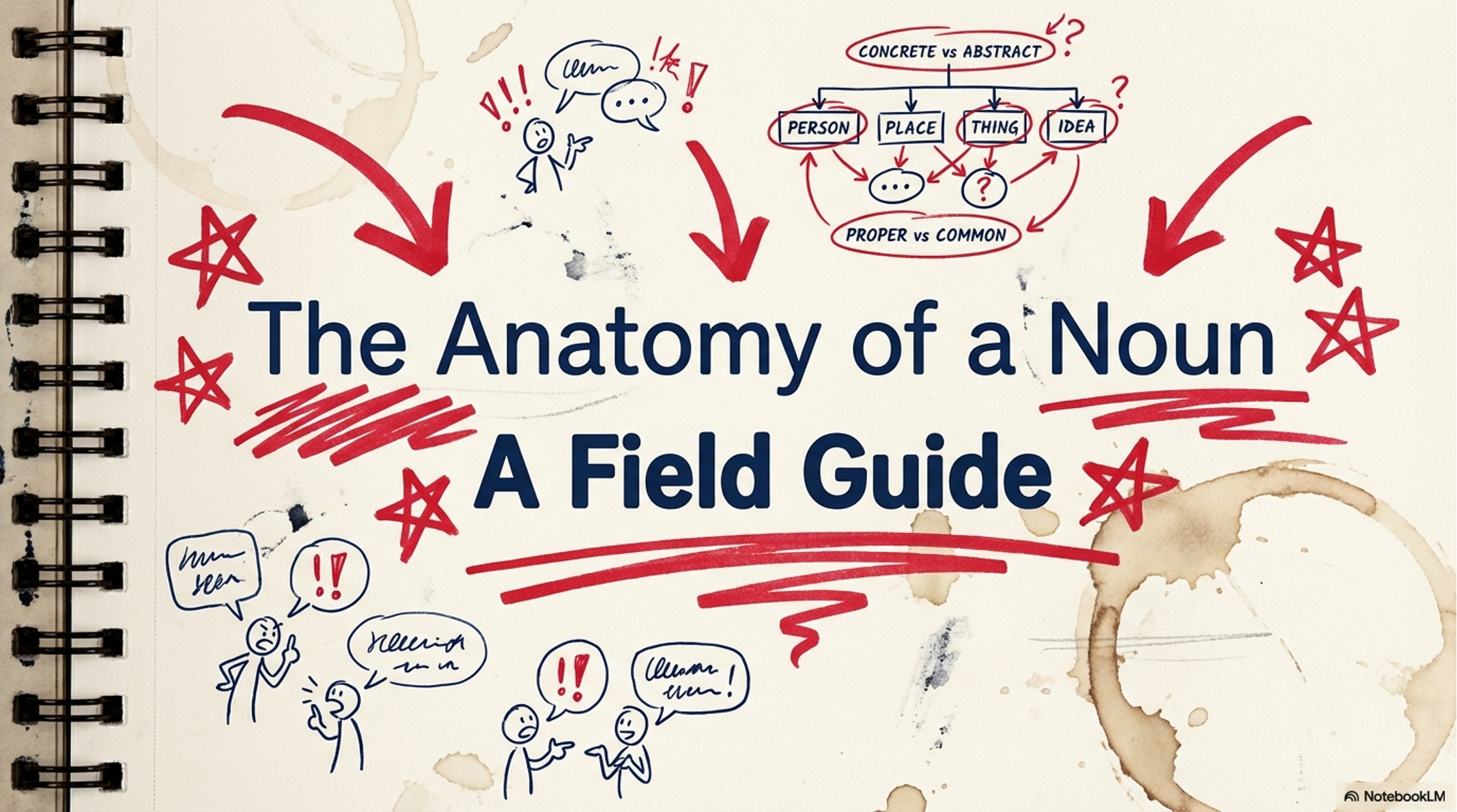
Visual Guide
Tap to view the presentation slides
Video Lesson
Watch a guided explanation
Audio Recap
Listen to a quick 60-second summary
Why learning nouns is important
- Name people, animals, places, objects, and ideas.
- Work as subjects, objects, complements, and objects of prepositions.
- Show number, possession, and classification.
- Build the core meaning of most English sentences.
| Type | Definition | Example |
|---|---|---|
| Common Noun | General name for a class of people, places, or things | teacher, city, river |
| Proper Noun | Specific name of a person, place, or thing | Anita, Delhi, the Nile |
| Concrete Noun | Something you can sense physically | book, apple, bell |
| Abstract Noun | An idea, quality, or feeling | honesty, courage, joy |
| Collective Noun | A group seen as one unit | team, flock, jury |
| Compound Noun | Two or more words acting as one noun | toothpaste, bus stop, mother-in-law |
What Nouns Name
Nouns identify the people, places, things, and ideas we talk about. Without nouns, our sentences would have action but no clear subject matter.
| What It Names | Explanation | Examples |
|---|---|---|
| Person | A human being or character | doctor, Meera, child |
| Place | A location or area | school, beach, Chennai |
| Thing | An object, animal, or material item | chair, tiger, pencil |
| Idea or Quality | Something you cannot touch but can think about | truth, freedom, anger |
Examples in Context
- Meera visited the museum on Sunday.
- The puppy chewed my slipper.
- Honesty builds trust in every friendship.
Major Types of Nouns
English grammar groups nouns by the kind of name they give. Learning these types helps you choose correct capitalization, articles, and agreement.
- Common Nouns: General names such as city, book, teacher, or flower.
- Proper Nouns: Special names such as India, Ravi, or the Himalayas.
- Abstract Nouns: Ideas and qualities such as love, bravery, and wisdom.
- Collective Nouns: Group names such as class, crowd, and bunch.
RULE 1: Capitalize proper nouns because they name specific people, places, or things.
RULE 2: Do not capitalize common nouns unless they begin a sentence or are part of a title.
RULE 3: An abstract noun names something felt or understood, not something seen or touched.
Examples in Context
- river is common, but Ganga is proper.
- beauty and patience are abstract nouns.
- A team entered the stadium together.
Number, Possession, and Compound Forms
Nouns change form to show one or many, ownership, or a combined name made from two words.
| Grammar Feature | Rule | Examples |
|---|---|---|
| Singular and Plural | Add -s or -es in many cases; some nouns change irregularly | book/books, child/children |
| Possessive | Add apostrophe plus s for ownership in most singular nouns | Riya's bag, the cat's tail |
| Plural Possessive | Add apostrophe after the plural noun ending in s | students' notebooks |
| Compound Noun | Two or more words together name one thing | bedroom, washing machine, sister-in-law |
Examples in Context
- One box, two boxes.
- The children's toys were on the floor.
- My grandfather fixed the washing machine.
Functions of Nouns in Sentences
Nouns can do different jobs in a sentence. Recognizing their function makes sentence analysis easier and improves writing accuracy.
RULE 1: A subject noun tells who or what performs the action: Birds sing.
RULE 2: An object noun receives the action: We watched the birds.
RULE 3: A noun can follow a preposition: The keys are on the table.
Examples in Context
- The teacher explained the lesson clearly.
- We visited the library after school.
- The flowers in the vase look fresh.
Practice Exercises
Test your understanding of this concept.
Q: Q1. Identify the noun: The baby laughed loudly.
Answer: baby
Q: Q2. Change to plural: leaf
Answer: leaves
Q: Q3. Make this possessive: the bag of Rani
Answer: Rani's bag