Conjunctions
A conjunction is a word that joins words, phrases, clauses, or sentences. Conjunctions help ideas connect logically and smoothly in speech and writing.
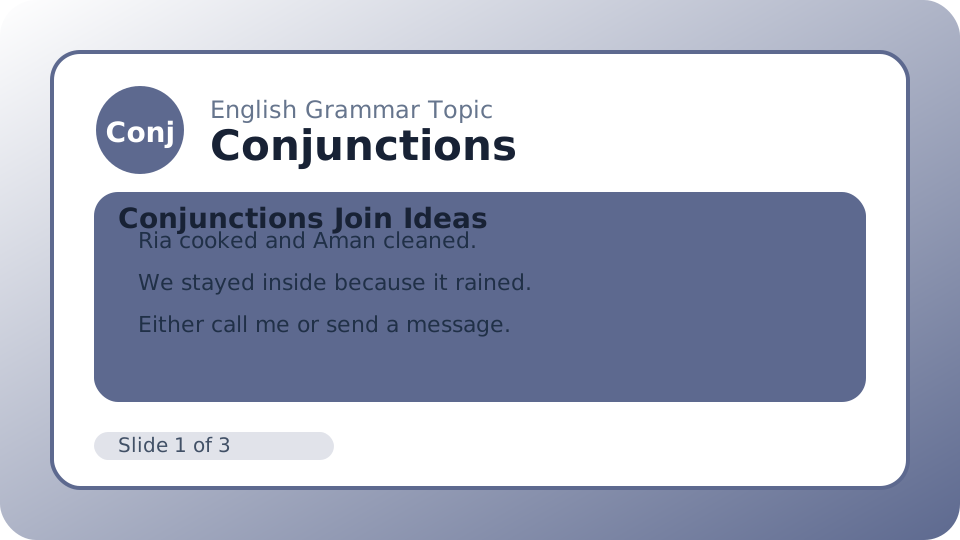
Visual Guide
Tap to view the presentation slides
Video Lesson
Watch a guided explanation
Audio Recap
Listen to a quick 60-second summary
Why learning conjunctions is important
- Join similar words or phrases.
- Connect independent and dependent clauses.
- Show addition, contrast, reason, result, and choice.
- Improve coherence in speaking and writing.
| Type | Definition | Example |
|---|---|---|
| Coordinating Conjunction | Joins equal words or clauses | and, but, or, so |
| Subordinating Conjunction | Introduces a dependent clause | because, although, if, when |
| Correlative Conjunction | Works in pairs | either...or, neither...nor |
| Conjunctive Adverb | Links ideas between clauses or sentences | however, therefore, moreover |
Coordinating Conjunctions
Coordinating conjunctions join words, phrases, or independent clauses of equal importance. The common set is remembered as FANBOYS.
| Conjunction | Meaning | Example |
|---|---|---|
| for | reason | She left early, for she was unwell. |
| and | addition | Arun sings and dances well. |
| nor | negative addition | He does not smoke, nor does he drink. |
| but | contrast | The road was narrow, but it was safe. |
| or | choice | Take a bus or hire a taxi. |
| yet | unexpected contrast | He is tired, yet he keeps working. |
| so | result | It was late, so we went home. |
Examples in Context
- The room was small but comfortable.
- Ritu and Meera prepared the presentation.
- Study now, or you may struggle later.
Subordinating Conjunctions
Subordinating conjunctions introduce dependent clauses and show relationships such as time, cause, purpose, condition, and contrast.
- Time: when, while, before, after, since, until
- Reason: because, since, as
- Condition: if, unless, provided that
- Contrast: although, though, whereas
Examples in Context
- We waited until the rain stopped.
- Because she prepared well, she answered confidently.
- Although he was tired, he finished the report.
Correlative Conjunctions and Conjunctive Adverbs
Correlative conjunctions come in pairs, while conjunctive adverbs link larger ideas and often need punctuation support.
RULE 1: Keep the same grammatical form after each correlative part: either tea or coffee, not either tea or to drink coffee.
RULE 2: Conjunctive adverbs often follow a semicolon and are followed by a comma: It rained; however, we continued.
Examples in Context
- Both the principal and the teachers attended the event.
- She was ill; therefore, she stayed home.
- Not only the captain but also the team supported the plan.
Common Errors and Practice
Learners often overuse and or choose the wrong connector. Selecting a conjunction based on relationship makes writing clearer.
Examples in Context
- Incorrect: He was tired because he kept working. Better: He was tired, but he kept working.
- Incorrect: Either you must study and leave. Better: Either you must study or leave.
- Correct: Since the shop was closed, we returned home.
Practice Exercises
Test your understanding of this concept.
Q: Q1. Name the conjunction in: I stayed home because I was sick.
Answer: because
Q: Q2. Fill in the blank: ________ Riya nor Asha was late.
Answer: Neither
Q: Q3. Join the clauses with a suitable conjunction: It was hot. We went for a walk.
Answer: It was hot, but we went for a walk. / Although it was hot, we went for a walk.