Adverbs
An adverb is a word that modifies a verb, an adjective, another adverb, or an entire sentence. Adverbs tell us how, when, where, how often, or to what degree something happens.
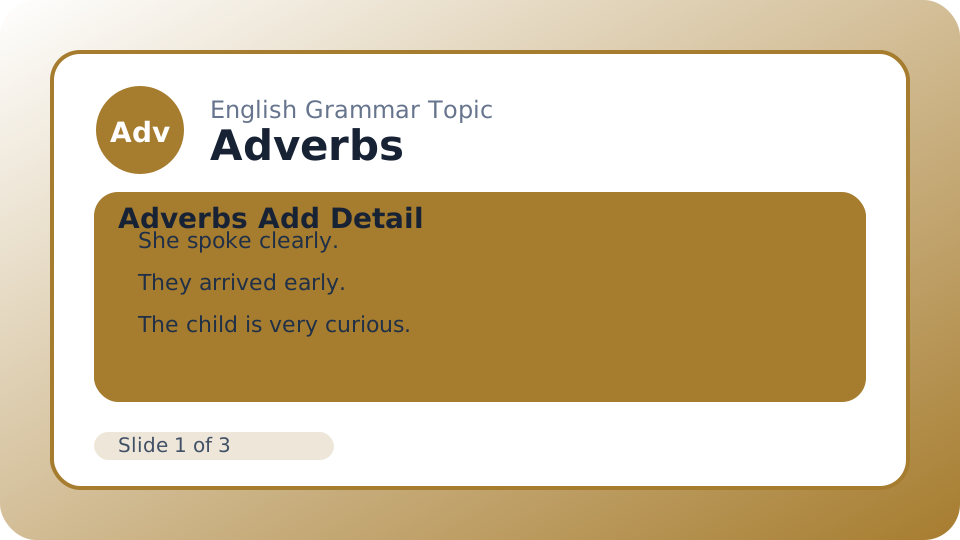
Visual Guide
Tap to view the presentation slides
Video Lesson
Watch a guided explanation
Audio Recap
Listen to a quick 60-second summary
Why learning adverbs is important
- Describe the manner of an action.
- Show time, place, frequency, and degree.
- Modify adjectives and other adverbs.
- Add precision to statements, questions, and instructions.
| Type | Definition | Example |
|---|---|---|
| Adverb of Manner | Shows how something happens | slowly, carefully |
| Adverb of Time | Shows when something happens | today, soon, yesterday |
| Adverb of Place | Shows where something happens | here, outside, everywhere |
| Adverb of Frequency | Shows how often | always, often, rarely |
| Adverb of Degree | Shows intensity or extent | very, quite, almost |
| Sentence Adverb | Comments on the whole sentence | fortunately, honestly |
Kinds of Adverbs
Adverbs can answer many different questions. Learning their jobs helps you place them correctly.
| Type | Question Answered | Examples |
|---|---|---|
| Manner | How? | carefully, loudly, gently |
| Time | When? | now, tomorrow, recently |
| Place | Where? | there, nearby, abroad |
| Frequency | How often? | often, never, sometimes |
| Degree | To what extent? | very, too, almost |
Examples in Context
- The nurse spoke softly to the patient.
- We will travel tomorrow morning.
- He almost missed the train.
Formation of Adverbs
Many adverbs are formed by adding -ly to adjectives, but some irregular forms must be memorized.
- Regular Formation: quick -> quickly, calm -> calmly, honest -> honestly
- y to ily: happy -> happily, easy -> easily
- Irregular Forms: good -> well, fast -> fast, hard -> hard, late -> late
RULE 1: Do not confuse adjectives and adverbs. She is a careful driver, but she drives carefully.
RULE 2: Some words can be both adjective and adverb: fast train, run fast.
RULE 3: Hardly does not mean hard. It means almost not.
Examples in Context
- He sings well, not good.
- The workers finished the road quickly.
- The train moved fast through the station.
Position of Adverbs
Adverbs may appear at the beginning, middle, or end of a sentence, depending on the meaning and type.
Examples in Context
- Fortunately, the bus arrived on time.
- I almost finished the assignment.
- They will probably attend the workshop.
Common Errors and Practice
Adverb mistakes often happen when adjectives are used after action verbs or when words like only are placed carelessly.
Examples in Context
- Incorrect: She sang beautiful. Correct: She sang beautifully.
- Incorrect: He drives reckless. Correct: He drives recklessly.
- Correct: Only Riya answered the question.
Practice Exercises
Test your understanding of this concept.
Q: Q1. Identify the adverb: The baby slept peacefully.
Answer: peacefully
Q: Q2. Fill in the blank: He completed the work ________. (careful)
Answer: carefully
Q: Q3. Name the type of adverb in: We meet weekly.
Answer: Adverb of frequency / time