Adjectives
An adjective is a word that describes or gives more information about a noun or pronoun. Adjectives tell us about quality, quantity, number, size, color, ownership, or identity.
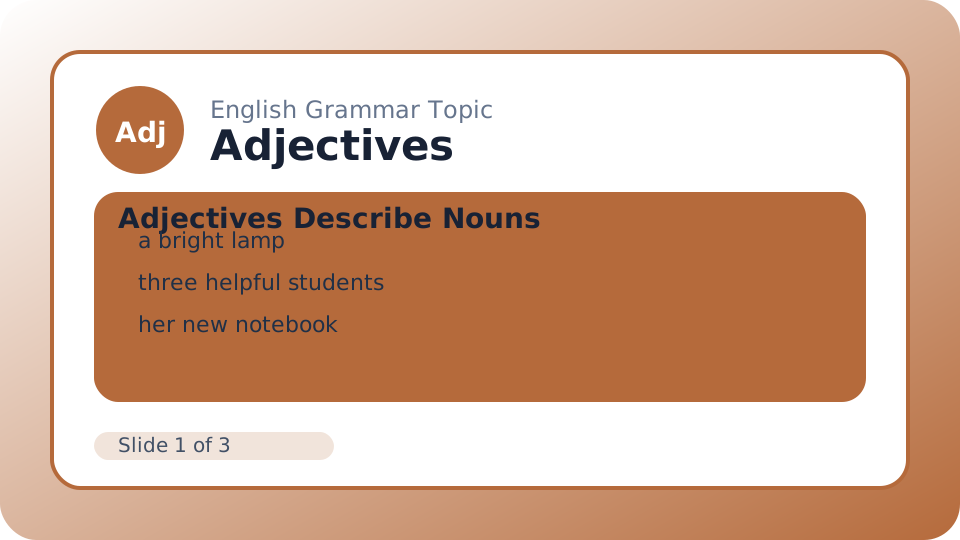
Visual Guide
Tap to view the presentation slides
Video Lesson
Watch a guided explanation
Audio Recap
Listen to a quick 60-second summary
Why learning adjectives is important
- Describe how someone or something looks, feels, or behaves.
- Show number, quantity, and order.
- Point out or identify particular nouns.
- Compare two or more people, places, or things.
| Type | Definition | Example |
|---|---|---|
| Descriptive Adjective | Tells quality or appearance | happy, blue, tall |
| Quantitative Adjective | Shows amount | some, much, little |
| Numeral Adjective | Shows number or order | three, first, many |
| Demonstrative Adjective | Points out nouns | this book, those chairs |
| Possessive Adjective | Shows belonging | my bag, their class |
| Interrogative Adjective | Helps ask about nouns | which road, what color |
| Proper Adjective | Comes from proper nouns | Indian food, French art |
Kinds of Adjectives
English uses many adjective groups. Each group answers a slightly different question about the noun.
| Type | Question Answered | Examples |
|---|---|---|
| Descriptive | What kind? | beautiful, noisy, brave |
| Quantitative | How much? | some, little, enough |
| Numeral | How many? Which number? | two, several, first |
| Demonstrative | Which one? | this, that, these, those |
| Possessive | Whose? | my, your, her, our |
Examples in Context
- She bought a red dress for the festival.
- There is enough water for everyone.
- Those students won the quiz competition.
Position of Adjectives
Adjectives usually come before nouns, but they can also follow linking verbs such as be, look, seem, feel, and become.
RULE 1: Use adjectives before nouns: a clever answer, a clean classroom.
RULE 2: Use adjectives after linking verbs: The classroom is clean. The soup smells delicious.
RULE 3: When several adjectives describe one noun, use a natural order: a beautiful old wooden chair.
Examples in Context
- The shy child hid behind her mother.
- The child was shy during the performance.
- They live in a small blue house near the river.
Degrees of Comparison
Adjectives can compare people or things. Use the positive degree for description, the comparative for two, and the superlative for three or more.
| Positive | Comparative | Superlative |
|---|---|---|
| tall | taller | tallest |
| easy | easier | easiest |
| beautiful | more beautiful | most beautiful |
| good | better | best |
| bad | worse | worst |
Examples in Context
- Ravi is taller than Kiran.
- This is the most useful chapter in the book.
- Today is better than yesterday.
Common Errors and Practice
Learners often confuse adjectives with adverbs or use the wrong comparison form. Checking the noun being described helps avoid mistakes.
Examples in Context
- Incorrect: She is more taller than me. Correct: She is taller than me.
- Incorrect: He is a well boy. Correct: He is a healthy boy.
- Correct: This is the best solution we found.
Practice Exercises
Test your understanding of this concept.
Q: Q1. Identify the adjective: The old bridge looks unsafe.
Answer: old, unsafe
Q: Q2. Fill in the blank with a possessive adjective: ________ brother is an engineer.
Answer: My / Your / His / Her / Our / Their
Q: Q3. Write the comparative and superlative of happy.
Answer: happier, happiest